- Sep 16
Inadvertent Intra-Arterial Injection of Sclerosants: Primary Evidence, Bedside Prevention, and Clinical Governance
- Haroun Gajraj
By Dr. Haroun Gajraj | VeinCare Academy
Dr. Haroun Gajraj is GMC-registered Vascular Specialist, Founder & Board Member of the British Association of Sclerotherapists (BAS).
16th September, 2026
TL;DR: Key Takeaways for Clinical Practice
Incidence: Intra-arterial sclerosant injection is exceedingly rare but carries severe risks of distal tissue necrosis, limb loss, and systemic toxicity.
Guideline Foundation: The 2024 international consensus guideline (Parsi et al.) consolidates five decades of sparse case reports and observational data.
Duplex Primacy: Prevention depends primarily on meticulous live duplex ultrasound guidance and accurate image interpretation, not resuscitation post-injection.
Immediate Protocol: In suspected arterial events: cease injection immediately, avoid compression, place the limb in a dependent position, and initiate urgent transfer to vascular surgery.
UK Medicolegal Context: Treatment standard of care relies on Bolam, but consent is governed by Montgomery, mandating explicit disclosure of catastrophic risks and the specific hazards of bilateral interventions.
Contents Summary
Understanding Incidence & Published Literature: Scrutinising 50 years of data from FAERS, French medico-legal archives, and European case series.
Prevention via Technique & Live Duplex Ultrasound: Why live imaging supersedes the emergency trolley, evidenced by catheter deviation and anatomical arterial variants.
Clinical Recognition & Diagnostic Differential: Distinguishing true intra-arterial injection from Veno-arteriolar Reflex Vasospasm (VAR-VAS).
Immediate Bedside Emergency Management: Four essential bedside actions to preserve limb perfusion before transfer.
Medicolegal Standards in the UK: Navigating Bolam vs Montgomery standards regarding bilateral procedures and informed consent.
Primary Source References: Full bibliographic indexing for clinical study.
Frequently Asked Questions (FAQs): AI-search optimised clinical answers on mechanisms, imaging, and protocols.
About the Author: Clinical background and expertise of Mr Haroun Gajraj.
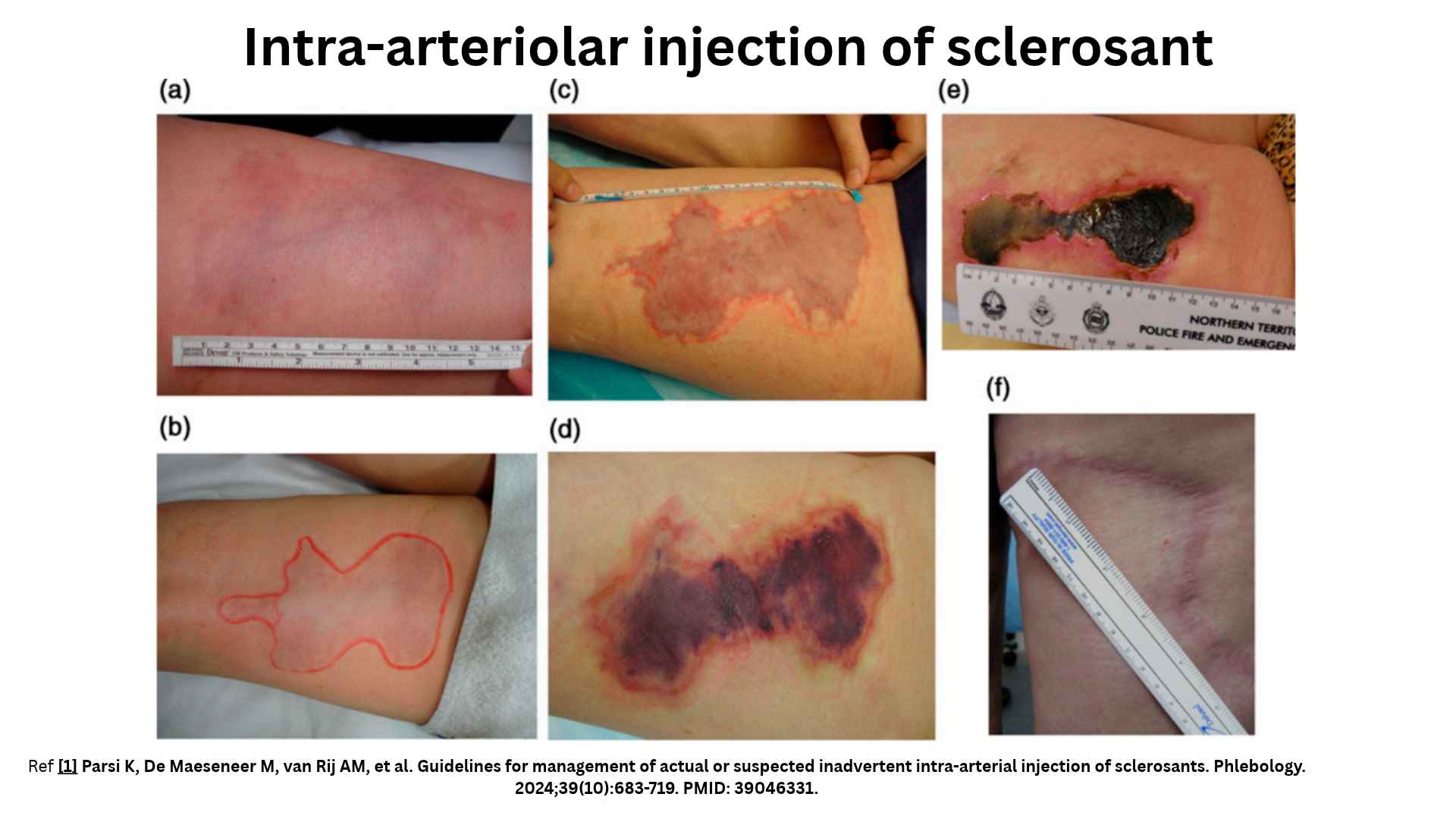
In 2024, an international multidisciplinary panel led by Kurosh Parsi published the first dedicated consensus guideline on inadvertent intra-arterial injection of sclerosants.[1] It was commissioned after a catastrophic New Zealand case in which bilateral injection into the dorsalis pedis arteries led to bilateral limb loss. Rather than simply summarising that guideline, this piece goes back to the primary literature behind it, to see what the underlying evidence actually says and where it runs thin.
How rare is this, and what do we actually know?
The honest answer is: rarer than almost anything else you will manage, and poorly captured by the data we have. A 2022 analysis of the FDA's Adverse Event Reporting System (FAERS) identified 1215 total adverse event reports across four sclerosants.[2] Within that dataset, a subset of 18 cases were coded specifically as injection site necrosis over a 51-year window (1970 to 2021). That specific breakdown is drawn from the 2024 guideline's own account of the study rather than from the published abstract, which does not report it. That is a passive reporting database, not a registry, so under-reporting is likely and the true rate is unknown.
Older case series tell a similar story from a different angle. Natali and Farman's 1996 review of French insurance case files covering 58 medico-legal claims identified 40 confirmed intra-arterial injections, resulting in seven amputations (two above-knee, five below-knee) and six further toe amputations.[3] A 1984 Swiss report by Oesch and colleagues described four accidental injections into the posterior tibial artery, all resulting in distal necrosis and one amputation.[4] Both papers are older, non-English-language reports (French and German respectively), and I have not been able to independently read the full text; the figures above are as reported in the secondary literature that cites them, including Parsi's own review, so treat them as indicative of severity rather than as a precise incidence estimate.
A 2013 Austrian review by Hafner and colleagues, titled plainly "Intra-arterial injection, a rare but serious complication of sclerotherapy," was one of the few dedicated reviews of this complication published before the 2024 guideline.[5] I have not read the full text, only the title and bibliographic record, but the title alone captures the same balance the 2024 guideline strikes: really rare, but capable of severe and permanent morbidity when it occurs.
Prevention starts with training and technique, not the emergency trolley
Two case reports illustrate why the guideline leans so heavily on training and technique rather than on the emergency response alone.
Grommes and colleagues reported a below-knee amputation following a catheter-directed sclerotherapy procedure performed without ultrasound guidance, in which the catheter deviated from the intended vein into the superficial femoral artery via an aberrant communication.[6] The published record for this case report carries no indexed abstract, so this level of detail comes via the 2024 guideline's own account of the case rather than something I have checked against Grommes's full text directly. As described, it is a clean illustration of the guideline's point that catheter-directed techniques are not inherently safer if ultrasound guidance is skipped.
Jones and Parsi described a case that shows the opposite outcome: a 69-year-old man with a history of small saphenous vein stripping was found, during ultrasound-guided sclerotherapy, to have pulsatile subcutaneous vessels in the posterior calf. The treatment was stopped, and subsequent imaging confirmed absence of the distal popliteal artery, with a cluster of arterial collaterals that had been masquerading as varicose veins.[7] Nothing was injected. That is the guideline's prevention argument in miniature: the same anatomical trap, caught and avoided because the practitioner was using, and correctly interpreting, live ultrasound.
The European Society for Vascular Surgery's 2022 guidelines on chronic venous disease place duplex ultrasound at the centre of assessment and treatment planning for superficial venous incompetence generally.[8] I have not read the full 267-page document closely enough to point to a specific duplex-competence recommendation, so I would put this cautiously: the wider vascular literature's emphasis on ultrasound is broadly consistent with, rather than independent proof of, the training and technique message in the 2024 guideline.
Recognising it when it happens
The clinical picture of intra-arterial injection was described as early as 1993, when Biegeleisen and colleagues reported seven cases and concluded plainly that the literature did not contain enough data to formulate a definitive prevention or treatment strategy for this complication.[9] Their closing line still holds: "the best 'treatment' is prevention." That conclusion has aged well; three decades on, the 2024 guideline is still built on consensus rather than trial evidence, for exactly the reason Biegeleisen identified.
A related but distinct picture, Veno-arteriolar Reflex Vasospasm (VAR-VAS), was first proposed as a mechanism by Tran and Parsi, based on a 2007 case report of skin changes following intravenous sclerotherapy of a markedly dilated small saphenous vein, with no arterial injection involved.[10] I have only seen this case described second-hand in later papers, not the original report itself, so what follows describes the mechanism it gave rise to rather than every clinical detail of that specific case. The distinction matters clinically: VAR-VAS follows an intravenous or intra-telangiectatic injection and tends to produce a smaller, more limited area of stellate necrosis than a true intra-arterial injection, whereas a true arterial injection follows the angiosome of the affected vessel and can be far more extensive.
If either pattern is suspected, the bedside sequence from the 2024 guideline remains the practical anchor: stop injecting immediately, do not apply compression, place the limb in a dependent position, and arrange urgent transfer to a facility with vascular or interventional capability.[1]
A brief word on the medicolegal picture
UK practitioners should note that the standard of care for treatment technique and the standard for informed consent are not governed by the same test. Bolam v Friern Barnet Hospital Management Committee established that a doctor is not negligent in their treatment if they acted in accordance with a practice accepted as proper by a responsible body of medical opinion.[11] But for consent specifically, UK law has since moved to the test set out in Montgomery v Lanarkshire Health Board: a doctor must ensure a patient is aware of any risk that a reasonable person in the patient's position would consider significant, or that the doctor knows this particular patient would.[12] Applied here, that means disclosure of the additional risk of a bilateral procedure, not just the risk of sclerotherapy in general, is the more demanding and more relevant test. Neither point is legal advice; if a case does arise, early advice from your medical defence organisation remains essential.
Bottom line
The primary literature underneath this guideline is thin, mostly case reports and case series spanning five decades, and the panel says as much itself. But the pattern across that thin literature is consistent: the cases that go well are the ones where ultrasound guidance was used and correctly interpreted, and the cases that go badly are disproportionately the ones where it was not. Training, personal duplex competence, and caution around high-risk anatomy and bilateral procedures are not just consensus opinion. They are the common thread running through every primary source behind this guideline.
For the practical side of prevention, my video on cannulation technique and the four criteria I use before every injection covers how this translates to the bedside.
References
[1] Parsi K, De Maeseneer M, van Rij AM, et al. Guidelines for management of actual or suspected inadvertent intra-arterial injection of sclerosants. Phlebology. 2024;39(10):683-719. PMID: 39046331.
[2] Nguyen CN, Nguyen Q-BD, Silapunt S. Analysis of adverse events with sclerosants reported to the United States Food and Drug Administration. Phlebology. 2022;37(6):452-459. PMID: 35442845. (The 18-case injection-site-necrosis breakdown cited in the text is drawn from the 2024 guideline's account of this study, not from the published abstract.)
Natali J, Farman T. [Forensic medical implications in the course of sclerotherapy of varicose veins]. J Mal Vasc. 1996;21:227-232. (French; figures as reported in secondary literature, not independently verified against full text.)
Oesch A, Stirnemann P, Mahler F. [Acute ischaemic syndrome of the foot following sclerotherapy of varicose veins]. Schweiz Med Wochenschr. 1984;114:1155-1158. (German; figures as reported in secondary literature, not independently verified against full text.)
[5] Hafner F, Froehlich H, Gary T, Brodmann M. Intra-arterial injection, a rare but serious complication of sclerotherapy. Phlebology. 2013;28(2):64-73. PMID: 22422795.
[6] Grommes J, Franzen EL, Binnebösel M, et al. Inadvertent arterial injection using catheter-assisted sclerotherapy resulting in amputation. Dermatol Surg. 2011;37(4):536-538. PMID: 21070468.
[7] Jones L, Parsi K. Arteries masquerading as varicose veins: a trap for phlebologists. Phlebology. 2015;30(10):729-735. PMID: 25062681.
[8] De Maeseneer MG, Kakkos SK, Aherne T, et al. European Society for Vascular Surgery (ESVS) 2022 clinical practice guidelines on the management of chronic venous disease of the lower limbs. Eur J Vasc Endovasc Surg. 2022;63(2):184-267. PMID: 35027279.
Biegeleisen K, Neilsen RD, O'Shaughnessy A. Inadvertent intra-arterial injection complicating ordinary and ultrasound-guided sclerotherapy. J Dermatol Surg Oncol. 1993;19(10):953-958. PMID: 8408915.
Tran D, Parsi K. Veno-arteriolar reflex vasospasm of small saphenous artery complicating sclerotherapy of the small saphenous vein. Australian and New Zealand Journal of Phlebology. 2007;10:29-32. (Not PubMed-indexed; bibliographic details cross-checked against multiple citing sources; abbreviation of the journal name varies across those sources.)
Bolam v Friern Barnet Hospital Management Committee [1957] 1 WLR 582.
Montgomery v Lanarkshire Health Board [2015] UKSC 11.
Frequently Asked Questions
What is the emergency bedside management for suspected intra-arterial injection of sclerosants?
Immediately stop the injection. Do not apply compression garments or bandages, place the limb in a dependent position to promote perfusion, and arrange emergent transfer to a unit with vascular or interventional radiology expertise.
How does intra-arterial injection differ from Veno-arteriolar Reflex Vasospasm (VAR-VAS)?
Intra-arterial injection involves direct chemical endarteritis within an arterial vessel, leading to extensive tissue ischaemia distribution across an entire angiosome. VAR-VAS is an intense neurovascular reflex following intravenous injection, frequently in dilated saphenous systems, that causes a localised, stellate cutaneous necrosis without direct cannulation of an artery.
Why does catheter-directed foam sclerotherapy still carry intra-arterial risk?
Blind or insufficiently imaged catheter navigation can allow the device to enter arteriovenous communications or aberrant arterial collateral vessels. Live duplex ultrasound tracking is essential to verify intraluminal positioning at all times.
What are the medicolegal requirements for sclerotherapy informed consent in the UK?
Following Montgomery v Lanarkshire Health Board, practitioners must disclose all material risks that a reasonable patient would consider significant. This includes rare, severe risks like skin necrosis and amputation, as well as the heightened risk profile associated with simultaneous bilateral procedures.
About the Author

This educational article is written and regularly reviewed by Dr Haroun Gajraj, a GMC-registered vein specialist who has treated thousands of patients with vein disease and has trained many doctors and nurses in microsclerotherapy, radiofrequency thermocoagulation, and related cosmetic vein procedures. Dr Gajraj is the founder and board member of the British Association of Sclerotherapists. You can view his current GMC registration and independent patient reviews on iWantGreatCare for further information about his clinical background.
Clinicians remain responsible for assessing each patient, obtaining informed consent, explaining risks and alternatives, and working within the scope of their professional registration and regulatory guidance.
Subscribe
For regular updates get my weekly newsletter here
© VeinCare Academy | Dr. Haroun Gajraj | veincare.academy
This article is intended for qualified healthcare professionals. All clinical decisions should be based on individual patient assessment, primary medical literature and current professional guidelines.