- Jul 1
Is 4 MHz the Optimum Frequency for Radiofrequency Thermocoagulation of Spider Veins?
- Haroun Gajraj
- Thermocoagulation
By Dr. Haroun Gajraj | VeinCare Academy | 1st July 2026
Written by Dr. Haroun Gajraj, GMC-registered Vascular Specialist, Founder & Board Member of the British Association of Sclerotherapists (BAS).
This review is written for healthcare professionals who perform, or are considering, radiofrequency thermocoagulation for leg and facial telangiectasias. It covers the underlying physics of percutaneous thermal vein clearance, defines the terminology used by device manufacturers, explains why 4 MHz has become the most frequently used operating frequency for this indication, and compares the principal devices currently available.
Summary for Busy Clinicians
The Core Mechanism: All percutaneous micro-needle vascular devices operate via the exact same physical principle—Joule heating. Proprietary terms like "Ohmic Thermolysis" are brand marketing rather than distinct clinical technologies.
Why 4 MHz? Operating at the 4 MHz band provides a critical safety margin by restricting energy penetration specifically to the superficial dermis (180 $\mu$m to 1 mm), precisely where target telangiectasias reside.
Biophysical Advantages: At 4 MHz, cell membranes undergo capacitive coupling, allowing the current to pass through endothelial walls for even thermal distribution and reliable vessel closure with minimal lateral thermal spread.
Device Reality: The vast majority of leading clinical systems (including ThermaVein, VeinGogh, and Veinwave) operate at or near 4 MHz. Clinical differences between them relate to build quality and operator skill rather than frequency.
Adjuvant Efficacy: Emerging randomized pilot evidence supports combining 4 MHz thermocoagulation immediately with liquid microsclerotherapy to induce vascular spasm, reduce trapped blood, and significantly lower the risk of post-inflammatory hyperpigmentation.
🎥 Prefer video? Watch the full review on YouTube: "Radio Frequency Thermocoagulation and Shortwave Diathermy for Spider Veins: Devices and Bio Physics" [→click here]
Contents
Introduction
The core physical principle: Joule heating
Terminology decoded: science versus marketing
Why 4 MHz is the most widely used therapeutic frequency
Device comparison
Combination with Microsclerotherapy: the adjuvant evidence
Key clinical points
References
1. Introduction
Walk the floor of any aesthetic medicine conference, or open an industry trade journal, and you will be met with a dense array of competing brand names, all claiming a clinical edge in clearing superficial telangiectasias.
Terms such as "Ohmic Thermolysis", "Advanced Radiofrequency", and "Shortwave Diathermy" appear across different brochures, sometimes referring to devices that operate at the same output frequency and the same physical mechanism.
For a clinician building an evidence-based cosmetic vein practice, this creates real confusion.
The question worth asking is whether these are distinct therapeutic technologies.
Understanding why 4 MHz has become the most widely used frequency for this indication follows from measurable biophysical properties that determine depth of penetration, thermal spread, and clinical safety.
2. The Core Physical Principle: Joule Heating
Before evaluating any individual device, it is useful to establish what every device in this category is actually doing.
An alternating electrical current at high frequency is delivered into tissue through a fine probe (also described as an electrolysis needle) placed next to the target vessel.
The tissue resists the flow of electrical current, and that resistance converts electrical energy into heat. This process is described by this equation equation:
Heat = Current squared x Resistance x Time
This is Joule heating, and it governs every percutaneous micro-needle vascular device on the market, regardless of the brand name applied to it. ThermaVein, VeinGogh, Viridex, Veinwave, and Epil 100 all operate on this principle.
The variables that differ between systems are power output, wave modulation, pulse spacing controls, and build quality.
The underlying mechanism is the same.
Endothelial coagulation occurs when sufficient thermal energy is delivered to the wall of the target vessel. The aim is to achieve this precisely, at the correct depth, without excessive lateral thermal spread to surrounding tissue.
That is where frequency selection becomes important.
3. Terminology Defined: Science Versus Marketing
The terms used across this device category are not interchangeable, and several are used loosely or inaccurately in practice. The following definitions are clinically useful.
Radiofrequency (RF): A broad engineering descriptor for any alternating electrical current operating between 3 kHz and 300 GHz. Within clinical vein practice, relevant devices typically operate between 0.3 MHz and 40 MHz. "Radiofrequency" alone does not specify a frequency or a clinical technique.
Shortwave Diathermy (SWD): Derived from the Greek for "through heat". In its strict technical meaning, shortwave diathermy refers to current operating at the internationally standardised Industrial, Scientific, and Medical (ISM) band of 27.12 MHz. This frequency is regulated to prevent telecommunications interference. The term is sometimes applied loosely in aesthetic practice to devices operating at much lower frequencies, including 4 MHz devices, which is technically inaccurate.
Thermocoagulation: A neutral, precise clinical descriptor for heat-mediated coagulation of a target tissue or vessel. This is the preferred terminology in peer-reviewed journals and international guidelines and is the term used in this article.
Ohmic Thermolysis: A proprietary marketing term created by Refine USA for their VeinGogh system, as recorded in their FDA 510(k) premarket notification (K112334) [1].
From a biophysics standpoint, ohmic thermolysis is a brand name for Joule heating. it doesn't describe a distinct clinical mechanism.
The practical implication is that when comparing devices, the only technically meaningful comparison is the verified operating frequency, the power output, and the published clinical evidence, not the brand language.
4. Why 4 MHz is the Preferred Therapeutic Frequency
Micro-needle vascular devices span a range from approximately 4 MHz to 27.12 MHz. The 4 MHz band, including devices operating up to approximately 4.2 MHz, has become widely accepted as the preferred frequency for treating superficial telangiectasias at a depth of 180 micrometres to 1 mm. Three biophysical properties explain this preference [2].
Superficial penetration depth
Lower-frequency electrosurgical units operating between 300 kHz and 1 MHz penetrate deeply into tissue, which increases the risk of scarring and collateral thermal damage beyond the target vessel. Operating at 4 MHz restricts the depth of energy penetration to the superficial dermis, which is precisely where telangiectasias and facial spider veins reside [2].
This depth-limiting effect is a consequence of the frequency itself. it is not an adjustable parameter. It provides a safety margin that lower-frequency systems do not.
Capacitive cell membrane coupling
At low frequencies, cell membranes present an electrical barrier that impedes current flow through the cell wall. At 4 MHz, this barrier breaks down: the membranes undergo capacitive coupling, allowing the alternating current to pass through the endothelial cell walls and distribute thermal energy evenly within the cells. The result is consistent, controlled endothelial coagulation with minimal lateral thermal spread to adjacent tissue [2].
Controlled thermal action radius
A 4 MHz current delivered through an insulated micro-needle creates a thermal action radius of approximately 3 mm from the uninsulated probe tip. This confined radius prevents surface epidermal burns while providing reliable vessel closure. The insulation of the needle shaft concentrates energy delivery at the tip rather than distributing it along the length of the probe.
When this localised thermal action is combined immediately with liquid Microsclerotherapy, it triggers an instant vascular spasm [3]. This limits the volume of trapped blood within the lumen and reduces the risk of post-inflammatory hyperpigmentation [3].
At 27.12 MHz, correctly described as shortwave diathermy, the depth and distribution of energy deposition differ. Whether 27.12 MHz devices produce clinically different outcomes from 4 MHz systems for superficial telangiectasias has not yet been examined in comparative trials.
5. Device Comparison
The table below compares the principal devices in current use, evaluated by their verified output frequency.
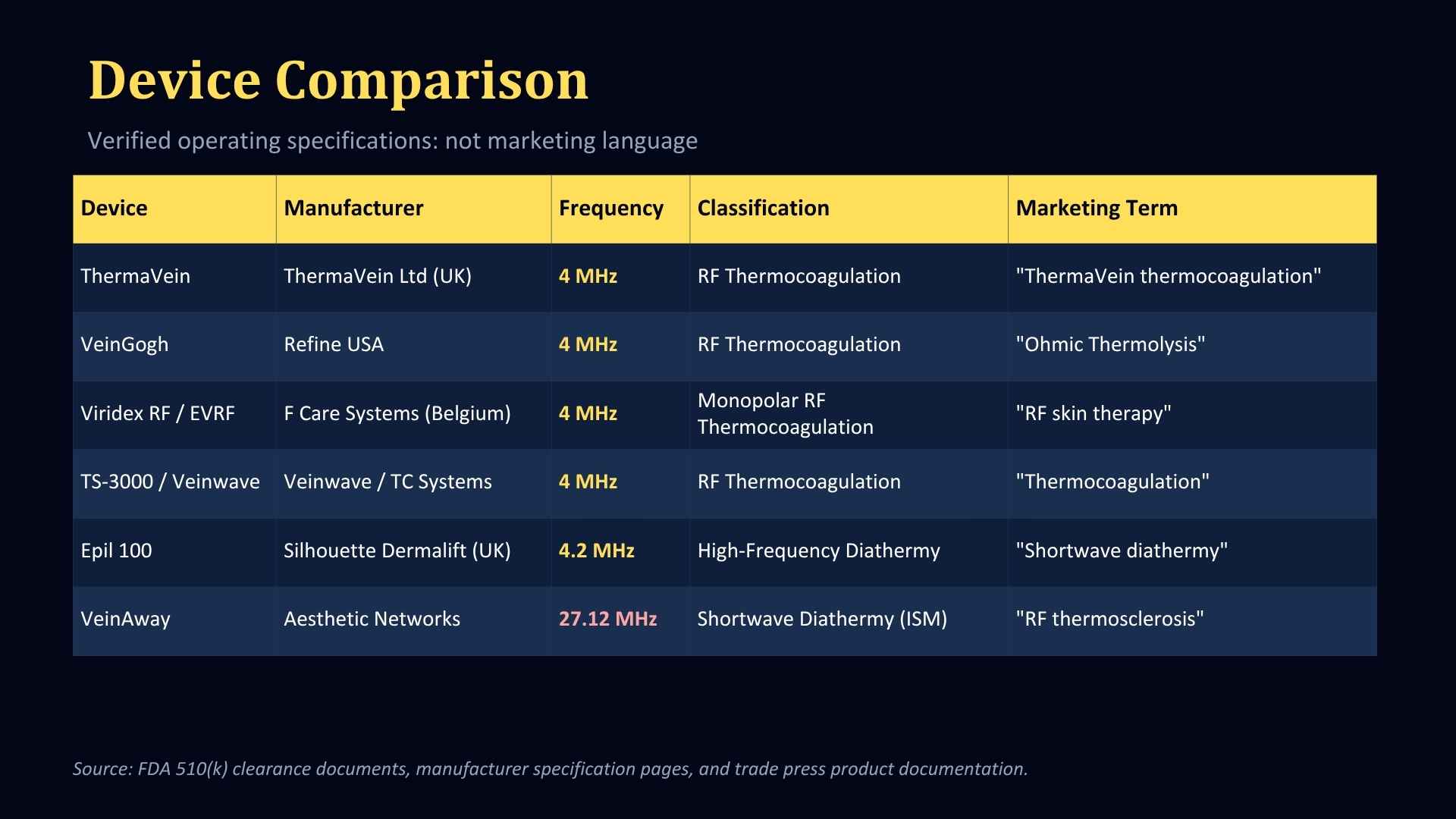
The 4.2 MHz specification for the Epil 100 has been confirmed by direct consultation with the manufacturer's technical engineering department [7].
The TC3000 / Veinwave platform is documented in FDA premarket clearance records as the predicate device for the VeinGogh system; both are confirmed at 4 MHz [1][4].
ThermaVein's 4 MHz frequency is documented in the same FDA clearance chain [4].
The VeinAway operating frequency of 27.12 MHz is confirmed in trade press product documentation published in Aesthetic Medicine [8].
The practical conclusion from this comparison is that the majority of devices used in UK clinics for telangiectasia treatment operate at 4 MHz or very close to it.
Differences in clinical outcome between these devices are likely to reflect engineering build quality, pulse control, and operator training rather than frequency alone.
6. Combination with Microsclerotherapy: the Adjuvant Evidence
The interaction between 4 MHz thermocoagulation and Microsclerotherapy is clinically relevant and supported by published randomised pilot evidence.
When thermocoagulation is applied immediately before or alongside liquid Microsclerotherapy, it triggers vascular spasm in the target vessel [3]. This limits the volume of blood retained within the lumen and, in turn, reduces the risk of haemosiderin deposition and post-inflammatory hyperpigmentation.
The strongest published evidence for this combination comes from a randomised pilot study by Diken et al. (2021), which enrolled 111 patients with CEAP C1 spider veins and compared liquid sclerotherapy alone with sclerotherapy plus low-energy RF thermocoagulation [3]. The adjuvant thermocoagulation group showed better self-assessed cosmetic outcomes, significantly less hyperpigmentation, and less trapped blood, without any increased risk of necrosis.
This is a pilot study, not a large-scale RCT, and the evidence base remains limited. However, it is the strongest published randomised evidence directly addressing the combination, and it aligns with the observed biophysical mechanism.
At VeinCare Academy, we teach both modalities and their combination as part of our structured training in cosmetic vein treatment. The approach is consistent with the published evidence: Microsclerotherapy remains the primary intervention for most C1 disease, with 4 MHz thermocoagulation used selectively, particularly for vessels too fine to cannulate reliably or in patients where hyperpigmentation has been a problem in previous courses of treatment.
7. Key Clinical Points
Every percutaneous micro-needle vascular device operates via the same underlying mechanism: Joule heating (Heat = Current squared x Resistance x Time). Brand terminology does not change this.
"Ohmic thermolysis" is not a distinct clinical technology. It is a proprietary label for RF thermocoagulation used by one manufacturer [1].
"Shortwave diathermy" strictly refers to 27.12 MHz. Applying this term to 4 MHz devices is technically inaccurate, though common in aesthetic practice.
4 MHz restricts energy penetration to the superficial dermis (180 micrometres to 1 mm), which is precisely where target telangiectasias reside [2]. This depth limitation is a consequence of the frequency and provides an inherent safety margin.
Capacitive membrane coupling at 4 MHz allows even distribution of thermal energy across endothelial cell membranes with minimal lateral thermal spread [2].
The thermal action radius of approximately 3 mm from the probe tip allows reliable vessel closure while protecting the overlying epidermis.
Most devices in current UK clinical use for telangiectasia treatment operate at 4 MHz or 4.2 MHz. The clinically relevant differences between them are likely to reflect engineering quality and operator training rather than frequency.
Randomised pilot evidence supports the combination of 4 MHz thermocoagulation with liquid Microsclerotherapy, showing better cosmetic outcomes, less hyperpigmentation, and fewer sessions compared with sclerotherapy alone [3].
8. References
U.S. Food and Drug Administration. 510(k) Premarket Notification K112334: VeinGogh Ohmic Thermolysis System. Refine USA, LLC. Available at: https://www.accessdata.fda.gov/cdrh_docs/pdf11/k112334.pdf
Chardonneau JM. Radiofrequency and telangiectasias. Int J Clin Expl Dermatol. 2018;3(2):1-5. Available at: https://fcaresystems.com/wp-content/uploads/2023/04/2018-Radiofrequency-and-Telangiectasia-J-M-Chardonneau.pdf
Diken AI, Alemdaroglu U, Ozyalcin S, et al. Adjuvant radiofrequency thermocoagulation improves the outcome of liquid sclerotherapy in the treatment of spider veins of the leg: a pilot study. Phlebology. 2021;36(8):620-626. PMID: 33813962. Available at: https://journals.sagepub.com/doi/10.1177/02683555211006534
U.S. Food and Drug Administration. 510(k) Premarket Notification K083352: TC3000 Thermocoagulation System. Newlands Clinical Trials Ltd. Available at: https://www.accessdata.fda.gov/scripts/cdrh/cfdocs/cfPMN/pmn.cfm?ID=K083352
Acolase. VeinGogh Ohmic Thermolysis System product specification sheet. Available at: https://acolase.com/uploads/veingogh2.pdf
F Care Systems. Viridex RF Generator product specifications. Available at: https://fcaresystems.com/products/generators/viridex-rf-generator/
Silhouette Dermalift. Epil 100 operating frequency: 4.2 MHz. Confirmed by direct communication with the manufacturer's technical engineering department.
Aesthetic Medicine. Naturastudios launch Vein Away treatment for telangiectasia. Published 6 October 2016; updated 27 March 2025. Available at: https://aestheticmed.co.uk/naturastudios-launch-vein-away-treatment-for-telangiectasia
Disclaimer:
Apart from the Epil 100, I have no personal experience using any of the specific devices mentioned in this article and I am not making any personal recommendations. Healthcare professionals must conduct their own independent research, due diligence, and comprehensive review of all manufacturer specifications—including power outputs, pulse spacing controls, build quality, warranties, guarantees, after-sales technical advice, and corporate training packages—prior to making a purchasing decision.
--
About the Author
This educational article is written and regularly reviewed by Dr Haroun Gajraj, a GMC-registered vein specialist who has treated thousands of patients with vein disease and has trained many doctors and nurses in microsclerotherapy, radiofrequency thermocoagulation, and related cosmetic vein procedures. Dr Gajraj is the founder and board member of the British Association of Sclerotherapists. You can view his current GMC registration and independent patient reviews on iWantGreatCare for further information about his clinical background.
This article is intended for healthcare professionals and is based on current clinical guidelines, peer-reviewed research, and day-to-day practice experience. The information here is general education only and is not a substitute for individual clinical judgement, local protocols, or formal training. Clinicians remain responsible for assessing each patient, obtaining informed consent, explaining risks and alternatives, and working within the scope of their professional registration and regulatory guidance.
Frequently Asked Questions (FAQs)
Q1: Is "Ohmic Thermolysis" safer or more effective than standard radiofrequency thermocoagulation?
No. "Ohmic Thermolysis" is a proprietary marketing term rather than a unique physical or clinical modality. Biophysically, it describes Joule heating—the exact same process of heat generation via tissue resistance that powers all micro-needle vascular devices. Clinical outcomes are determined by the operator’s skill, pulse settings, and device build quality, not trademarked vocabulary.
Q2: Can 4 MHz devices be technically classified as "Shortwave Diathermy"?
No, this is technically inaccurate. True shortwave diathermy refers strictly to devices operating at the internationally regulated Industrial, Scientific, and Medical (ISM) band of 27.12 MHz. While some aesthetic manufacturers loosely use "shortwave diathermy" to describe 4 MHz or 4.2 MHz devices, they are operating at a completely different frequency band with distinct biophysical properties.
Q3: Why choose a 4 MHz device over a lower-frequency electrosurgical unit?
Lower-frequency systems (operating between 300 kHz and 1 MHz) penetrate deeply into the tissue, significantly increasing the risk of collateral thermal damage and dermal scarring. In contrast, a 4 MHz frequency limits energy penetration precisely to the superficial dermis (180 micrometres to 1 mm), matching the exact depth of target telangiectasias and offering an inherent safety margin.
Q4: How does capacitive coupling benefit vessel clearance at 4 MHz?
At lower frequencies, cell membranes act as electrical barriers that resist current flow. At 4 MHz, the membranes undergo capacitive coupling, allowing the alternating current to pass directly through the endothelial cell walls. This ensures even, highly controlled thermal distribution within the target vessel while minimizing lateral heat spread to the surrounding skin.
Q5: Should I use thermocoagulation instead of, or alongside, microsclerotherapy?
At VeinCare Academy, we view them as complementary modalities rather than competing ones. Microsclerotherapy remains the gold standard for most CEAP C1 spider veins. However, 4 MHz thermocoagulation is highly effective as an adjunct tool for vessels too fine to reliably cannulate, or when used immediately alongside liquid sclerotherapy to trigger vascular spasm, reduce trapped blood, and minimize post-inflammatory hyperpigmentation.
Subscribe
For regular updates get my weekly newsletter here
© VeinCare Academy | Dr. Haroun Gajraj | veincare.academy
This article is intended for qualified healthcare professionals. All clinical decisions should be based on individual patient assessment, primary medical literature and current professional guidelines.
*All references in this blog have been checked against publicly available sources (for example, PubMed and official guideline websites), but this is an educational blog post, not a peer-reviewed journal article. Minor discrepancies in author lists, page numbers or indexing details may remain, and readers should always refer to the original publications and current clinical guidelines before making clinical decisions.