- Aug 5
Best Microsclerotherapy Training Courses in the UK: 2026 Comparison & BAS Standards Guide
- Haroun Gajraj
- Training Courses , Microsclerotherapy training courses
How to Choose a Microsclerotherapy Training Course in the UK
By Dr. Haroun Gajraj | VeinCare Academy | 5th August 2026
Written by Dr. Haroun Gajraj, GMC-registered Vascular Specialist, Founder & Board Member of the British Association of Sclerotherapists (BAS).
There is no shortage of places in the UK claiming to teach Microsclerotherapy for the treatment of leg telangiectasia. What's missing is a complete look at the market that states plainly what can and can't be verified about each one.
This article does that.
It covers every currently active UK provider identified in a February 2026 market-wide survey carried out independently by Dr Richard Oliver, and then organised against the draft training standards now being developed by the British Association of Sclerotherapists (BAS).
I have analysed the information from Dr Oliver's provider survey and the draft training standards from the British Association of Sclerotherapists, and I've carried out further research of my own. I've tried to be exact about what the available information actually tells you, and equally clear about what it doesn't.
TL;DR Summary for Busy Clinicians
The Issue: The UK Microsclerotherapy training market is largely unregulated, with significant variation in entry requirements, trainer credentials, group sizes, and practical assessment methods.
The Benchmark: The British Association of Sclerotherapists (BAS) is drafting new training standards requiring medical/nursing registration, active high-volume clinical practice, maximum 6:1 delegate-to-trainer ratios, CQC-registered venues, and objective competency-based assessments.
The Market Reality: A market-wide survey reveals that very few UK training providers publicly disclose their trainer qualifications, audit outcomes, or assessment criteria.
-
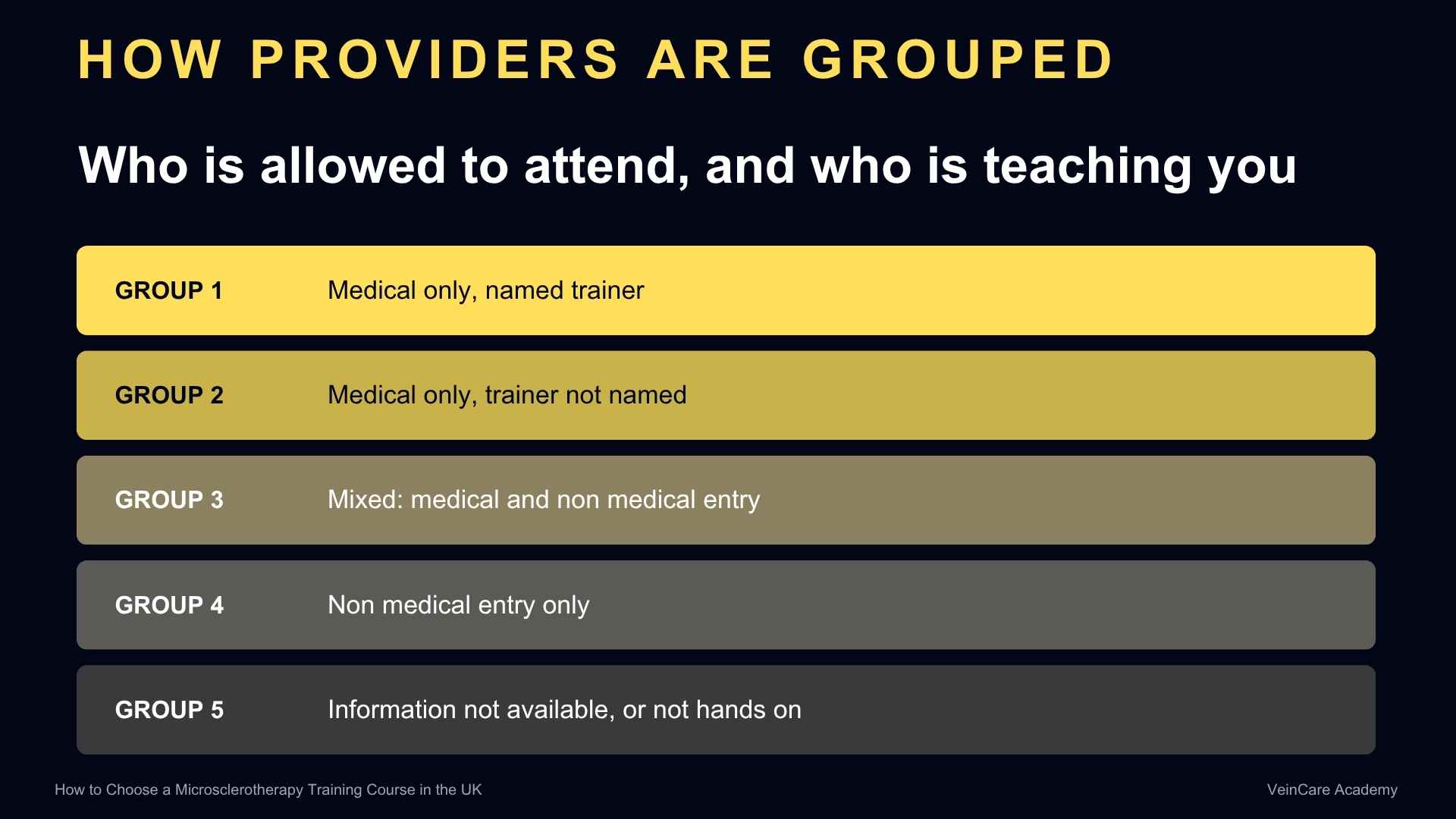
Provider Categories: Providers broadly fall into 4 groups:
Regulated Medical Only + Named Trainer: (e.g., Cosmetic Courses, VeinCare Academy, London Aesthetic Academy).
Regulated Medical Only (No Trainer Named): (e.g., You Can Clinic, Cosmedic Training Academy).
Mixed Entry: Accepting healthcare professionals alongside Level 3/4 non-medical beauty therapists.
Non-Medical Entry / Online Only: Requiring no medical registration, or delivering theory/manuals without supervised hands-on training.
Key Advice: Before booking any course, contact the trainer and directly request verification of trainer patient volumes, prescriber status, group sizes, emergency protocols, and structured assessment methods.
🎥 Prefer video? Watch the full review on YouTube: "(How to Choose a UK Microsclerotherapy Course: Independent Review & Checklist)" [ click here ]
Table of Contents
TL;DR Summary for Busy Clinicians
Sources and Method
Disclosure
The Checklist, in Brief
Group 1: Entry Restricted to Regulated Healthcare Professionals, with a Named Trainer and Trainer Qualifications
Group 2: Entry Restricted to Regulated Healthcare Professionals, No Named Trainer Disclosed
Group 3: Mixed Entry, Healthcare Professionals and Non-Medical Delegates Both Accepted
Group 4: Non-Medical Entry Only
Group 5: Information Not Available, or Not a Hands-On Course
How to Use This
FAQs
About the Author
Disclaimer & Author Disclosure
Sources and Method
This review is based on two sources only:
A structured survey of UK sclerotherapy training providers conducted independently in February 2026, by Dr. Richard Oliver, covering every provider he could identify, active or since discontinued.
The draft BAS training standards, currently being finalised by a subgroup of the BAS board with input from independent experts.
The BAS draft standards ask for things like:
a trainer who has personally treated at least 100 patients by microsclerotherapy in the last two years
structured audit of their own complications and satisfaction rates
a group ratio of no more than six delegates per trainer
a CQC-registered training venue
objective, structured assessment of delegates rather than simple attendance certification
Here is the uncomfortable truth: almost none of that is publicly disclosed by almost all providers, including some of the more established ones.
So rather than pretend to score providers against criteria I can't actually check, I've organised this review around the two things the survey data does tell you for most providers:
1. Who is allowed to attend. Is the course restricted to regulated healthcare professionals (doctors, dentists, nurses, pharmacists, and similar), does it mix healthcare professionals with non-medical beauty-sector delegates, or is it open to non-medical delegates only?
2. Whether a named clinician trainer is disclosed, and whether the course appears to still be running, based on the most recent confirmed dates.
The answer to these two questions tells us a lot. Entry criteria and named trainers are at least a visible, checkable proxy for how seriously a provider has thought about who should be doing this procedure. It does not verify trainer qualifications, patient volumes, audit records, CQC status or assessment methodology for any individual provider.
Where I know something further about a specific provider from direct verification, I say so and I say how I know it. Where I don't, I say that too.
Where a website page returns a "not found" message, or where I cannot find evidence of a Microsclerotherapy course in the menu system, I have not included that course provider in this article.
Disclosure
I run one of the providers in this list, VeinCare Academy. I have applied the same method to my own course as to everyone else's.
The information in this article and the information provided does not reflect the opinions or views of any organisation or colleague with which I am associated, including but not limited to Dr Richard Oliver and the British Association of Sclerotherapists.
The information in this article has been obtained by a detailed internet search of each provider's website. I have not personally contacted each provider requesting specific details.
The Checklist, in Brief
Before the provider review, here is what the draft BAS standards look for:
Trainer: medical or nursing degree, independent prescriber, active GMC/NMC licence, trainer qualification, significant recent patient volume, structured audit of outcomes and complications, current BLS/anaphylaxis training, BAS membership, indemnity insurance.
Curriculum: anatomy and physiology, reflux recognition, patient selection, sclerosant pharmacology, injection technique, compression therapy, ultrasound fundamentals, complication management, consent and documentation, follow-up, taught with live models, not theory alone.
Practical delivery: no more than six delegates per trainer in a hands-on session, ideally a CQC-registered venue, at least twelve months of post-course support, the option to shadow a refresher session later.
Patient safety: documented emergency protocols, immediate anaphylaxis medication on-site, ideally a defibrillator within easy reach.
Assessment: a structured, objective checklist of technical milestones, not just a certificate of attendance.
Ask any provider below directly about these. Very few publish the answers to all.
A note on how current this section is: I re-checked every link against the live provider website in August 2026, after the February survey, including all providers the survey had marked as no longer available. Several details had already changed: prices, entry criteria.
Group 1: Entry Restricted to Regulated Healthcare Professionals, with a Named Trainer and Trainer Qualifications
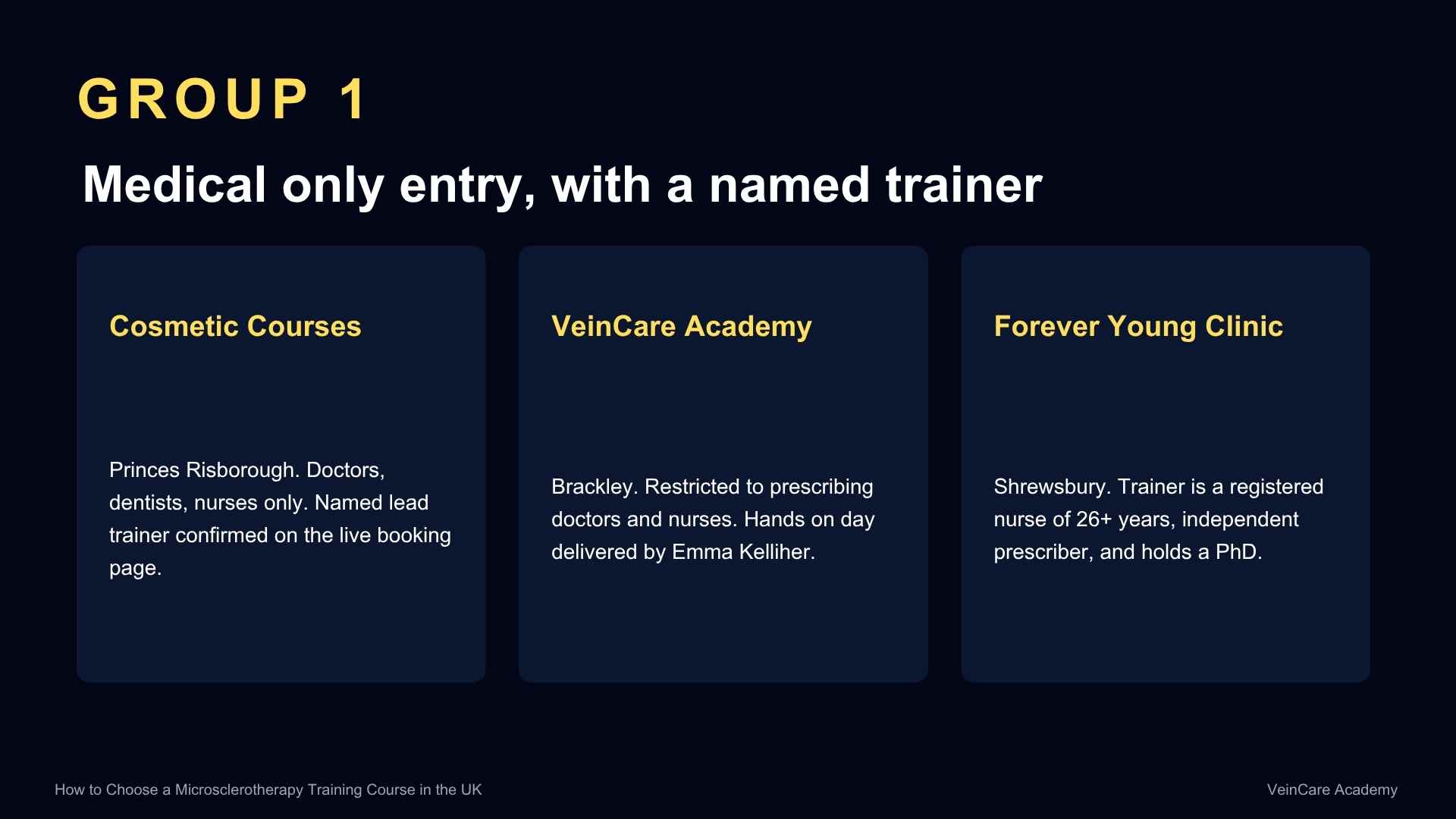
This is the smallest and, on the available evidence, most reassuring group: courses that both restrict entry to registered healthcare professionals and tell you who is actually teaching you. If you are looking for one of the best Microsclerotherapy training courses, I would suggest this is the first group to look at.
Cosmetic Courses, Princes Risborough, Buckinghamshire. £700 + VAT (£840 total), 8 hours. Entry: doctors, dentists, nurses only (GMC, GDC or NMC registration required, confirmed on the live booking page). The live page names Shiva Dindyal as lead trainer; Gaynor Hughes is named as co-faculty in the original survey rather than on this specific page, and was separately confirmed as a BAS board member appointed in 2022 in recognition of her standing as a microsclerotherapy trainer, a verifiable credential rather than a marketing claim, even though it's sourced from two different places rather than one. Course dates are published on the website and are current.
VeinCare Academy, hands-on practical training at The EK Clinic, Brackley, Northamptonshire; access to the online theory portal is included, £1,500. 8 CPD points for completing the online Microsclerotherapy course (subject to passing an online quiz). 8 CPD points for the Hands-on Microsclerotherapy Practical Day (Microsclerotherapy skills assessed against specific objective criteria). Course material and online portal maintained by me, Dr Haroun Gajraj. Course material regularly updated and completely reviewed annually. Named practical trainer: Emma Kelliher, who holds a formal teaching qualification and runs her own Aesthetic Clinic and busy cosmetic vein practice. Restricted to prescribing doctors and nurses. Access to the online theory portal is available to purchase separately as stand-alone educational material and is also included with the hands-on course. Healthcare professionals who attend the practical Microsclerotherapy hands-on course have lifelong access to the online theory portal and are invited to a private WhatsApp group for ongoing support and advice. The VeinCare Academy also provides Hands-on Shortwave Diathermy (radiofrequency thermocoagulation) courses. Delegates are given a clear training pathway for developing a cosmetic vein practice after attending the courses. Course dates are prominently published on the VeinCare Academy website and are up to date.
Forever Young Clinic, Shrewsbury, with sessions also run in London, Wrexham or at the delegate's own clinic. £995, one full day. This one moved up from "information not available" once I checked the live page directly: the named trainer is Clare Spalding, a registered nurse of over 26 years who is also an independent (medical) prescriber and holds a PhD. The page doesn't state formal entry criteria for delegates, so I can't confirm this is medical-only, but the trainer's own credentials are well documented. CQC registered. No course dates published.
Group 2: Entry Restricted to Regulated Healthcare Professionals, No Named Trainer Disclosed
These restrict entry appropriately, but the survey could not identify who is actually delivering the training.
Rachel Goddard Aesthetics / RG Clinics, Ramsbottom, near Manchester. Price not publicly stated. Entry: doctors, dentists, nurses. No trainer named beyond the practice name itself. At the time of writing this article, the website was not active and had been temporarily disabled. This provider may no longer be providing Microsclerotherapy training.
You Can Clinic, Cardiff, Swansea, Bristol. £550, 5 hours. Entry confirmed on the live page as licensed medical professionals with experience of injectable treatments. It is an approved JCCP (Joint Council for Cosmetic Practitioners) training centre, and the course is explicitly capped at 4 delegates. No individual trainer named, though the page states trainers are practising doctors and nurses. Course dates are published.
Group 3: Mixed Entry, Healthcare Professionals and Non-Medical Delegates Both Accepted
These accept a mix of registered healthcare professionals and non-medical delegates with a beauty or needling background, which will suit some readers and not others depending on how strictly medical you want the training to be.
Aesthetics Lounge Academy, Walsall. £599, 1 day. Entry as either a registered professional pin (nurse, doctor, dentist, midwife, pharmacist, physiotherapist) or Level 3 beauty therapy with at least 6 months' needling experience (mixed, not medical-only). Trainer described only as having "registered medical backgrounds." Course dates not published on the website.
Little Beauty Academy, Hoddesdon, Hertfordshire. £500 (the live price; the survey recorded £610), 1 day. Also corrected: the live page lists entry as NVQ Level 3 beauty or equivalent, or nurse, dental nurse, doctor, dentist, pharmacist, or Level 4 micropigmentation with Level 3 anatomy and physiology. That is mixed entry, not the medical-only route the original survey data suggested. No trainer named. No course dates on the website.
Cosmetic College (in-person), Orpington, Kent. £600, 1 day, with live upcoming dates confirmed on the booking page (12 September and 22 October 2026 at time of checking). Entry is recorded in the original survey as doctors, nurses, aesthetic practitioners, advanced beauty professionals, and qualified aestheticians; that specific list wasn't visible on the live page itself, so treat it as the survey's record rather than a fresh confirmation, alongside the price and dates which are freshly confirmed.
Aesthetics Palace, Cheshire, London, Bolton. £599. Moved into this group after checking the live page directly: it explicitly states the course is "perfect for" both medical professionals and beauty therapists. No trainer named.
Beauty Worx, Ormskirk. £500 + VAT. The survey noted this page as inaccessible behind a CAPTCHA; it loaded without issue when I checked directly, and confirms entry for "Medics and Non-Medics," including SPMU practitioners and NVQ Level 3 beauty therapists. No course dates on the website.
Ava Training, Belfast. £599. Entry: doctor, or Level 3 beauty therapy. Trainer given only as a first name, Thomas. No course dates on the website.
Creative Touch, Rustington, West Sussex. £499, no current dates for 2026. Entry: healthcare practitioner, medic or nursing background; or SPMU practitioner with 6 months' experience; or an access-course route into aesthetics; or NVQ Level 3 beauty therapy with 6 months' experience in a "blood-breaking" service.
Empire Academy of Aesthetics, Liverpool, Chester. £750, confirmed live. Entry stated simply as doctors, nurses, aesthetic practitioners, and "anyone looking to expand their expertise in vein care," which is broad enough to warrant asking exactly who ends up in the room. Course dates on the website.
Flawless Luxe, Coventry. £495, 1 day, confirmed live. Explicitly marketed as open to both medics and non-medics, with accepted backgrounds including meso-therapy, tattoo artistry, body piercing and microblading alongside registered healthcare roles. No dates stated on the website.
Skiin Pro Aesthetic Training, multiple locations (Birmingham, Bournemouth, Twickenham, Bristol, Hertfordshire, Braunton). £499, no course dates on the website. The provider's site describes itself generally as training "medical and non-medical practitioners."
Best You Training, online blended, £185, with an optional in-person classroom day. Marketed as suitable for "a medical professional looking to expand your skills or a newcomer eager to enter the field." No course dates on the website.
Group 4: Non-Medical Entry Only
These do not require any medical, dental, nursing or pharmacy registration at all. That doesn't necessarily mean the training is poor, but it does mean the trainer qualification and clinical governance criteria in the draft BAS standards, which assume a prescribing, GMC- or NMC-registered trainer, are least likely to be met by default, and are worth asking about directly rather than assuming.
a-training, Grantham, Lincolnshire. £795 + VAT (confirmed live), 1 day. Entry: Level 3 beauty therapy or an access-to-practice route.
Beauty by Rebecca, Wakefield. £800. Entry: Level 3 anatomy plus 12 months' experience in electrolysis, needling or injectables. I couldn't re-verify this page directly (it blocked automated access).
Bella Mai Academy, Essex. £600, 1 day, confirmed live. Entry: VTCT Level 3 beauty or VTCT Level 3 anatomy and physiology, plus 6 to 12 months' needling experience. Named trainer: Terri Tibbles. She is a BUPA-registered micropigmentation therapist.
EVJ Training Academy, Manchester (Dukinfield, Cheshire). £349, 1 day. The site was showing a maintenance page rather than the course listing when I checked, so treat this as the last-known survey position rather than a live confirmation.
Flawless Academy & Beauty, Ashton-under-Lyne, Manchester. Price £495. Entry: prior completion of foundation dermal filler or foundation anti-wrinkle training, plus 6 months' needle experience, a prerequisite based on injectables experience rather than professional registration. Another correction to the survey, which recorded this provider as no longer listing microsclerotherapy; the page is live and describes the course directly.
Group 5: Information Not Available, or Not a Hands-On Course
For these, I still couldn't establish entry criteria, a named trainer, or reliable pricing.
Cosmedic Training Academy, no course dates listed since February 2022.
Cosmetic College (online theory only; now tiered at £99.99 for the course alone or £199.99 with tutor-reviewed case study, up from the survey's flat £99). The provider's own FAQ is explicit that this "does not include hands-on injecting, supervised assessment or clinical competency sign-off": theory preparation only, not a substitute for practical training.
Evolve Beauty Hub, confirmed live at £50.40 (discounted from £72). This is a downloadable training manual sold on Etsy, not a hands-on course, and is meant to be used by other academies as teaching material rather than by an individual practitioner as standalone training.
Hydurage, I couldn't confirm current details.
LC Beauty & Aesthetics (Wigan; £399, confirmed live): the product description states you receive a manual by email and then contact the provider by phone "to complete your course." This does not read as in-person hands-on training in the way the other entries here do; confirm directly what completing the course actually involves before booking.
Rising Dawn Aesthetics (York; £550 + VAT), named trainer Dawn Muir, entry criteria not stated anywhere I could find.
The Lulworth Clinic (Birkdale, Southport; named trainer Angela Kerr; £600). Entry criteria not stated, but worth noting this is one of only a few providers in the whole survey that publishes an actual objective competency checklist (history-taking, consent, aseptic technique, and so on) rather than just a syllabus.
VVV Beauty clinic (Knightsbridge and Harrow; £400, confirmed live), described as "expert medical training" but no formal entry criteria stated.
How to Use This
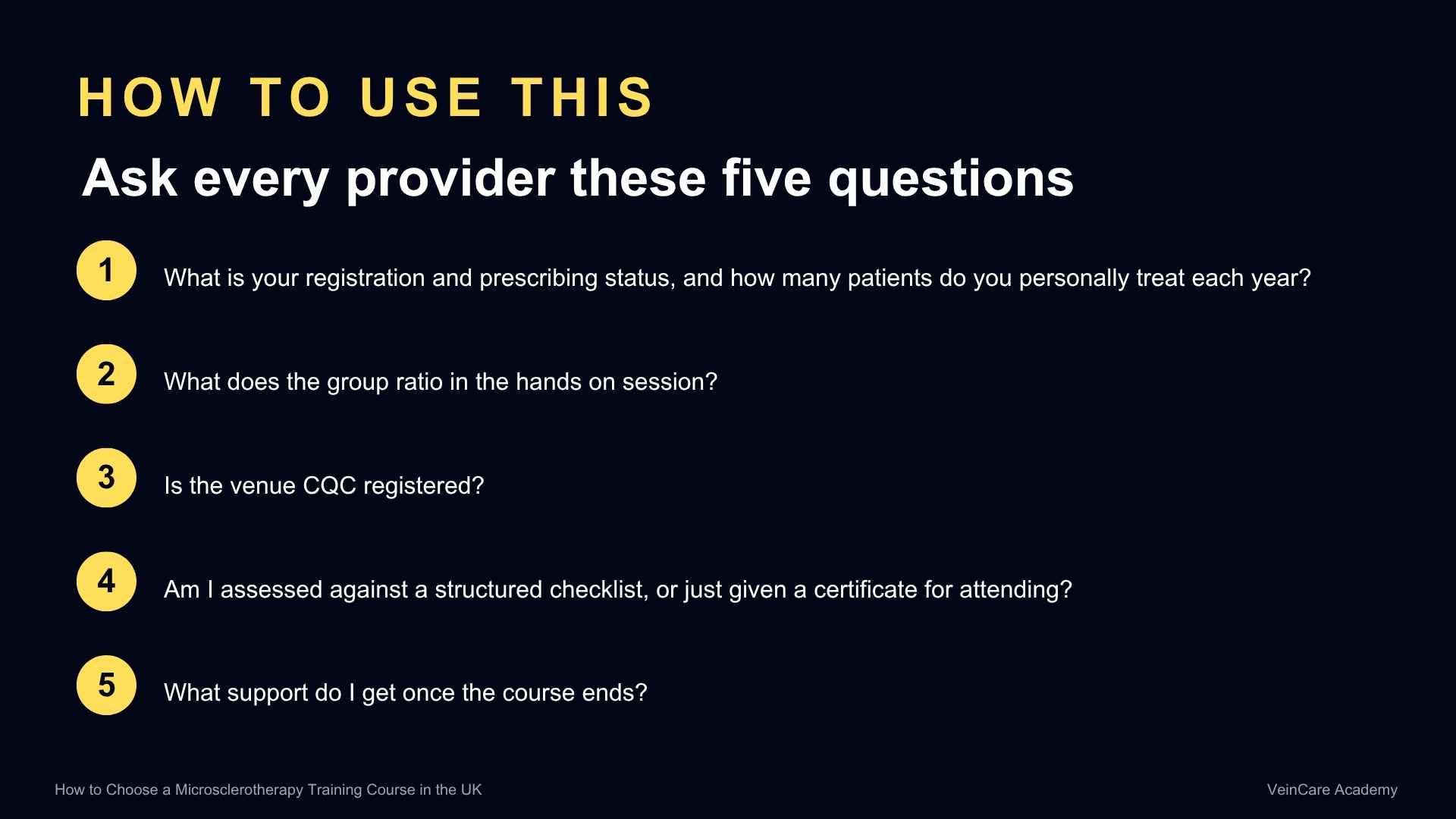
Start with the checklist, not the marketing. Whichever provider you're considering, ask directly:
What is the trainer's professional registration and prescribing status, and roughly how many patients do they personally treat by microsclerotherapy each year?
What does the group ratio actually look like in a hands-on session?
Is the venue CQC-registered?
Are you assessed against a structured checklist, or simply given a certificate for attending?
What support do you get once the course ends?
None of the groupings above is a substitute for asking these questions directly. They tell you what is publicly checkable right now, until the finalised BAS standards will eventually require a properly approved provider to demonstrate.
FAQs
What are the draft BAS training standards for microsclerotherapy?
The British Association of Sclerotherapists (BAS) is developing standards to improve safety and quality in sclerotherapy training. Key draft requirements include:
Trainers must hold an active GMC/NMC registration, be independent prescribers, and have treated at least 100 microsclerotherapy patients in the past two years.
Practical hands-on training must be capped at a maximum ratio of 6 delegates per trainer.
Training venues should ideally be CQC-registered.
Courses must evaluate delegates using a structured, objective technical milestone checklist rather than issuing simple certificates of attendance.
Who can legally perform microsclerotherapy in the UK? (Medics vs Non-Medics)
Currently, entry requirements depend entirely on the training provider and insurance requirements. While some courses restrict delegates strictly to registered healthcare professionals (doctors, dentists, and nurses), others accept non-medical delegates, such as Level 3 or 4 beauty therapists and semi-permanent makeup (SPMU) practitioners. However, because sclerosants (e.g., Sodium Tetradecyl Sulfate) are prescription-only medications (POMs), non-prescribing practitioners must establish a legal prescribing pipeline or work alongside an independent prescriber.
Can I learn microsclerotherapy via an online or theory-only course?
While e-learning modules and manuals can teach anatomy, sclerosant pharmacology, and patient selection, theory alone does not qualify a practitioner to safely perform injectables. BAS draft standards emphasize supervised, hands-on clinical practice with live models and structured competency sign-offs before treating patients independently.
What questions should I ask a training provider before booking?
Before enrolling, ask the provider directly:
Is the lead trainer a practising, registered healthcare professional who regularly treats spider veins?
What is the maximum number of delegates per trainer during hands-on sessions?
Is the practical training conducted in a CQC-registered facility?
How is my clinical competency assessed at the end of the course?
What post-course clinical support or shadowing opportunities are provided?
About the Author

This educational article is written and regularly reviewed by Dr Haroun Gajraj, a GMC-registered vein specialist who has treated thousands of patients with vein disease and has trained many doctors and nurses in microsclerotherapy, radiofrequency thermocoagulation, and related cosmetic vein procedures. Dr Gajraj is the founder and board member of the British Association of Sclerotherapists. You can view his current GMC registration and independent patient reviews on iWantGreatCare for further information about his clinical background.
Clinicians remain responsible for assessing each patient, obtaining informed consent, explaining risks and alternatives, and working within the scope of their professional registration and regulatory guidance.
Subscribe
For regular updates get my weekly newsletter here
© VeinCare Academy | Dr. Haroun Gajraj | veincare.academy
This article is intended for qualified healthcare professionals. All clinical decisions should be based on individual patient assessment, primary medical literature and current professional guidelines.
⚠️ Disclaimer & Author Disclosure
Author Disclosure: I run the VeinCare Academy. As a result, the information and operational details provided for VeinCare Academy within this survey are more comprehensive and directly verified than those for other entries. While every effort has been made to evaluate all providers objectively against the same criteria, readers should be aware of this inherent unintentional and sometimes unconscious bias.
Due Diligence Notice: This review is for informational, educational, and guidance purposes only. Course prices, entry criteria, venue CQC statuses, and trainer details across the UK market change frequently. Healthcare professionals seeking a hands-on microsclerotherapy training course must conduct their own independent research, direct enquiries, and due diligence before making a financial or professional commitment to any course provider.
General Notice: Neither the author nor VeinCare Academy accepts liability for decisions made or courses booked based on the information provided in this review. Inclusion or exclusion of a provider does not constitute a formal endorsement or condemnation.
For Providers: If you are a provider mentioned in this article and the information about you is incorrect, please contact me and I will update the information at your request.